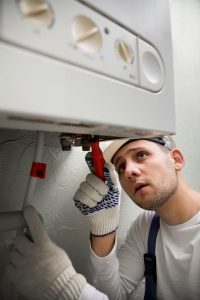
A leaking water heater is not something to ignore. Even a small puddle can quickly turn into serious water damage. In many homes, what starts as a slow drip becomes a flooded basement in just a few hours.
The good news? A leaking water heater does not always mean you need a full replacement. The key is knowing where the leak is coming from and acting fast.
This guide explains:
- What to do right away
- How to find the leak source
- When a repair is possible — and when replacement is the only option
Prefer to skip the troubleshooting and book a pro? Visit our Repair Service page: Water Heater Repair – Mas Air Home Comfort or Call us at 1-855-795-1199.
Step 1: Stop the Damage Immediately
How to Shut Off a Water Heater That’s Leaking
If you see water around your water heater, act right away. Do not wait.
Follow these emergency steps:
1. Shut off the water supply
Find the cold water inlet valve at the top of the tank.
Turn it clockwise until it stops.
This prevents more water from entering the heater.
2. Shut off power or gas
- Electric water heater: Turn off the breaker
- Gas water heater: Turn the gas control knob to OFF
Never leave a leaking water heater running.
3. Drain the tank (only if needed)
If water is spreading quickly:
- Attach a garden hose to the drain valve at the bottom
- Run the hose to a floor drain or outside
If the leak is slow, draining is usually not required.
📸 Tip: Take photos before cleanup. This helps with insurance claims if damage has already started.
Step 2: Find the Leak Source
How to Locate a Water Heater Leak
Once the water is under control, check where the leak starts. The location tells you how serious the problem is.
Work from top to bottom.
1. Leak at the Top: Pipe Connections
What you’ll see:
Water dripping from where pipes connect to the tank.
What it usually means:
- Loose fittings
- Corroded connections
How serious is it?
Low. This is often a simple repair.
Dry the area, wait a few minutes, and check again to confirm the source.
2. Leak on the Side: T&P Valve
What you’ll see:
Water coming from the temperature and pressure (T&P) valve or the discharge pipe.
What it usually means:
- Tank pressure is too high
- Water temperature is too hot
- Or the valve itself has failed
Important:
This is not a DIY repair.
The T&P valve is a critical safety device.
3. Leak at the Bottom: Tank Itself
What you’ll see:
Water pooling under the heater or seeping from the base.
What it usually means:
The internal tank liner has corroded and cracked.
Can it be fixed?
❌ No.
A water heater leaking from the bottom must be replaced.
Step 3: What Each Leak Means
| Leak Location | What It Means | Repair or Replace |
|---|---|---|
| Top (pipe joints) | Loose or corroded fittings | Repair |
| Side (T&P valve) | Valve failure or pressure issue | Professional diagnosis |
| Bottom (tank body) | Internal corrosion | Replace |
Step 4: DIY vs. Call a Professional
Safe to Do Yourself
- Shut off water and power/gas
- Clean and dry the area
- Identify and document the leak
Call a Professional Immediately
- Water heater leaking from the bottom
- T&P valve leaking or spraying
- You can’t find the source
- The leak is getting worse
⚠️ A bottom-of-tank leak can turn into a burst with little warning.
Need Same-Day Help in the GTA?
A leaking water heater should be handled the same day.
At Mas Air Home Comfort, our licensed technicians provide fast diagnosis and honest advice — whether that means a repair or a full replacement.
Water Heater Repairs & Emergency Service:
📞 +1 (855) 795-1199
New Water Heater Installation Estimates:
📞 +1 (647) 360-6623
You can also book online to request a free estimate or service visit.
Related Reading (Keep Troubleshooting Smart)
Don’t let a minor fault turn into a major breakdown. Explore our expert guides to identify other common water heater issues in your GTA home:
- No Hot Water — icy surprises or stone-cold taps.
- Inconsistent Hot Water — fluctuating between perfect warmth and an ‘icy spike’.
- Pilot Light & Ignition Issues — gas heater won’t fire up or the pilot light keeps going out.
- Strange Water Heater Noises — popping, rumbling, or banging sounds while heating.
- Low Hot Water Pressure — hot water flow is a weak trickle compared to cold taps.
- Smelly or Discolored Water — water smells like ‘rotten eggs’ or looks rusty.
FAQs
Yes — only if the leak is from pipe connections or fittings.
If the tank itself is leaking, replacement is required.
If it’s a minor pipe leak, you may have a short window to repair it.
If the tank is leaking, do not continue using it.
It usually means the tank has reached the end of its life.
Most units fail this way after 10–12 years.
Sometimes.
Hot water or heavy discharge = urgent
Slow drip = same-day service
Never cap or block a T&P valve.